Dubai has become an important destination for businesses exploring cryptocurrency, blockchain technology and Web3 solutions. Its growing digital economy, international business environment and developing virtual asset regulatory framework have attracted entrepreneurs, technology companies and investors interested in establishing a presence in the UAE.
One of the options available to these businesses is the Dubai Multi Commodities Centre (DMCC). Through its Crypto and Blockchain Ecosystem, commonly known as the DMCC Crypto Centre, the free zone supports companies involved in areas such as crypto trading, mining, blockchain development and virtual asset-related services.
A DMCC Crypto Licence can provide the commercial foundation for an eligible crypto or blockchain business. However, obtaining a commercial licence does not automatically authorise a company to provide every type of virtual asset service. Businesses involved in regulated activities may also need approval from Dubai's Virtual Assets Regulatory Authority (VARA).
This distinction is important when planning a crypto business in Dubai. A company developing blockchain software may have a different licensing route from a company operating a virtual asset exchange, providing custody services or managing client investments. Choosing the wrong activity can lead to additional costs, delays or restrictions on the services the company can offer.
This guide explains the DMCC Crypto Centre, potential business activities, licensing requirements, application stages, estimated costs, VARA authorisation, renewal and ongoing compliance responsibilities. It also highlights the points entrepreneurs should assess before committing to a particular business model.
What Is a DMCC Crypto License?
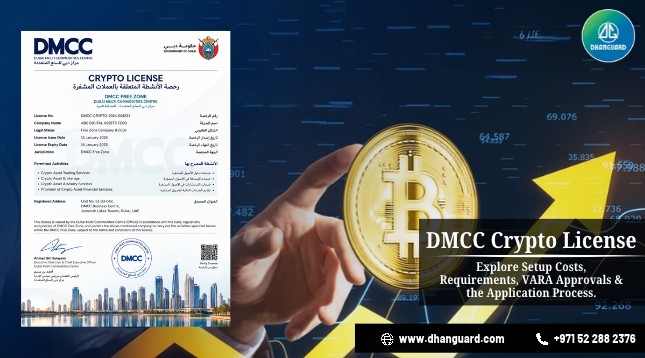
A DMCC Crypto Licence is a commercial licence issued through DMCC for eligible businesses operating in the cryptocurrency, blockchain and related technology sectors. It allows a company to establish its business within the DMCC free zone under the activities approved by the authority.
The licence is intended for businesses whose operations fall within the activities accepted by DMCC. Depending on the proposed business model, this may include technology development, mining-related operations, crypto trading and certain virtual asset-related services.
However, the exact activity wording and regulatory requirements must be confirmed before applying. A commercial activity approved by DMCC should not be interpreted as permission to provide a regulated virtual asset service without any additional authorisation.
Understanding the DMCC Crypto Centre
The DMCC Crypto Centre is part of DMCC's wider Crypto and Blockchain Ecosystem. It provides a business environment for startups, established companies, technology developers and investors working in the digital asset sector.
Its offering includes company licensing options, workspace facilities and access to an ecosystem of businesses and industry programmes. The centre also promotes networking, collaboration, mentoring and opportunities to connect with other participants in the blockchain and Web3 industry.
For entrepreneurs, the benefit is not limited to company registration. Being part of an industry-focused ecosystem can provide access to relevant business networks and a workspace designed to support crypto and blockchain companies.
The DMCC Crypto Centre package currently lists a company licence, access to its co-working facility and ecosystem benefits. Package inclusions and prices should be reconfirmed with DMCC before an application is submitted.
Purpose of a DMCC Crypto License
The purpose of the licence is to provide an eligible crypto or blockchain business with a recognised commercial structure in Dubai. It establishes the company's permitted business activities and provides a basis for carrying out approved operations from the DMCC free zone.
Depending on the approved activity, a DMCC company may be established for purposes such as:
- Developing blockchain-based software and applications.
- Providing eligible cryptocurrency technology services.
- Conducting approved mining-related activities.
- Offering permitted crypto or blockchain consultancy.
- Carrying out trading or other virtual asset-related activities where the relevant regulatory conditions are met.
The licence also allows the company to complete its corporate formalities, arrange an eligible workspace and apply for relevant immigration facilities, subject to the applicable DMCC requirements.
It is important to separate the commercial purpose of the licence from financial or virtual asset regulatory permission. A company that intends to hold or manage customer assets, execute transactions for clients or operate an exchange should assess the VARA requirements before starting its operations.
Who Can Apply for a DMCC Crypto License?
Entrepreneurs, investors, technology professionals and existing companies may explore setting up a crypto or blockchain business through DMCC, subject to the authority's eligibility and due diligence requirements.
- Potential applicants include:
- Individual entrepreneurs establishing a new crypto or blockchain company.
- Technology founders developing blockchain or Web3 products.
- Existing companies expanding their operations into Dubai.
- Corporate groups establishing a UAE subsidiary.
- Businesses involved in eligible cryptocurrency mining or technology services.
- Companies exploring permitted virtual asset-related services.
DMCC will assess the proposed business activity, ownership structure and supporting information. Where the applicant intends to conduct regulated virtual asset activities, the company must also follow the applicable VARA process.
What Business Activities Can Be Conducted Under This Licence?
DMCC's Crypto and Blockchain Ecosystem covers a range of crypto-related business models, including trading, mining, advisory, management and investment-related services. The ecosystem also supports blockchain and Web3 businesses.
However, these descriptions should not be treated as a list of independently available commercial licence activities or as confirmation that every activity can be conducted without regulatory approval.
The final activity selection depends on the actual services the company intends to provide. DMCC should confirm the permitted activity wording, while VARA should be consulted where the business model falls within its regulatory perimeter.
Types of DMCC Crypto Licences and Permitted Business Activities
The right business activity depends on how the company will earn revenue, what services it will provide and whether it will deal with customers' virtual assets. For example, a company that develops blockchain software for third-party businesses has a different operating model from a company that executes trades for customers. Similarly, mining digital assets does not automatically mean the company is providing an exchange or brokerage service.
The following categories are useful business models to assess when planning a DMCC crypto company. They should not be understood as a guarantee that each category is available as a separate DMCC licence.
Cryptocurrency Trading Licence
Cryptocurrency trading involves buying and selling digital assets. The regulatory position depends on whether the company trades only for its own account or provides services to customers.
Own-account trading A business may intend to buy and sell virtual assets using its own funds. This is generally described as proprietary trading. However, proprietary trading is not automatically outside regulatory oversight.
VARA identifies a separate route for virtual asset proprietary trading. Depending on the applicable conditions and trading volumes, a business may need a No Objection Certificate (NoC) or registration with VARA. The commercial licensor's process and VARA's requirements should therefore be checked before trading begins.
Trading on behalf of customers A company that executes transactions, arranges trades or provides access to virtual asset markets for customers may fall within a regulated activity, such as broker-dealer or exchange services, depending on the exact operating model.
Such businesses should not assume that a DMCC commercial licence alone is sufficient. The company may need a VARA licence and must satisfy the relevant governance, capital, compliance and operational requirements.
Before selecting a trading-related activity, clarify:
- Whether the company will trade its own funds or customer funds.
- Whether it will execute or arrange transactions for customers.
- Whether it will operate a trading platform.
- Whether it will hold or control customer virtual assets.
- Which regulatory category applies to the proposed services.
Cryptocurrency Mining Licence
Cryptocurrency mining involves using computing resources to support the operation of a blockchain network. Depending on the network, mining equipment may perform calculations to validate transactions and participate in the process through which new blocks are added.
A mining business may involve:
- Purchasing and operating mining hardware.
- Setting up computing infrastructure.
- Managing equipment and cooling systems.
- Monitoring power consumption and hardware performance.
- Maintaining network connectivity and operational security.
- Managing mined digital assets as part of the company's business model.
Mining businesses should assess the practical requirements before selecting a location. Electricity availability, cooling, ventilation, equipment noise, premises suitability and operating costs can have a significant impact on the business.
The proposed activity should also be reviewed with DMCC. If the company intends to provide additional services involving customer assets or regulated virtual asset activities, those services may require a separate regulatory assessment.
Distributed Ledger Technology (DLT) Services
Distributed Ledger Technology (DLT) refers to systems that record and share information across a network of participants. Blockchain is one form of DLT.
Businesses in this category may develop or provide technology solutions such as:
- Distributed ledger infrastructure.
- Blockchain application development.
- Enterprise blockchain platforms.
- Digital record management systems.
- Blockchain integration services.
- DLT-based workflow and verification solutions.
For example, a technology company may develop a blockchain-based supply chain platform that allows businesses to track the movement of goods. Another company may create a distributed database solution for document verification.
The regulatory position depends on the actual service. Developing software or providing technology infrastructure is not automatically the same as conducting a regulated virtual asset activity. However, a business that also operates a platform for regulated transactions or controls customer assets should assess the additional requirements.
Blockchain and Web3 Development Activities
Blockchain and Web3 development businesses focus on building applications and digital products using blockchain technology.
Their work may include:
- Smart contract development.
- Decentralised application (dApp) development.
- Web3 website and platform development.
- Blockchain-based gaming solutions.
- Token-related technology development.
- Wallet software development.
- Blockchain integration and technical consultancy.
A company may develop a smart contract for a client without necessarily providing a regulated virtual asset service. However, if the company also issues virtual assets, operates a regulated platform, manages customer investments or performs another regulated function, further approval may be required.
The distinction between developing technology and operating a financial or virtual asset service should be clear in the company's business plan and licence application.
Virtual Asset Advisory Services
Virtual asset advisory services involve providing advice or recommendations relating to virtual assets. The exact regulatory position depends on the nature of the advice, the customer relationship and the services offered.
Examples may include:
- Advising clients on virtual asset investment strategies.
- Providing recommendations about virtual asset transactions.
- Offering advice on virtual asset portfolio allocation.
- Advising businesses on virtual asset-related financial products or services.
A company offering general blockchain technology consultancy may have a different regulatory position from a business giving investment recommendations about virtual assets.
VARA regulates virtual asset advisory services as a regulated activity. Therefore, a business intending to provide regulated virtual asset advice in or from Dubai should assess the applicable VARA authorisation requirements before offering the service.
Virtual Asset Management and Investment Services
Virtual asset management and investment services involve managing or making investment decisions concerning virtual assets for customers or funds. Depending on the business model, services may include:
- Managing virtual asset portfolios.
- Making investment decisions on behalf of clients.
- Managing virtual asset funds or investment structures.
- Providing discretionary virtual asset management.
- Operating investment strategies involving virtual assets.
These services can involve significant regulatory responsibilities because the business may be making decisions about assets belonging to customers or investors.
VARA identifies management and investment services as a regulated virtual asset activity. Businesses considering this model should assess the applicable capital, governance, risk management, custody and client asset protection requirements.
Important: The categories discussed above are business models to investigate, not a claim that each is independently available as a DMCC commercial licence. Confirm the exact activity wording and regulatory route with DMCC. Where the proposed service is regulated, the relevant VARA authorisation must also be obtained before the company begins that activity.
DMCC Crypto License vs VARA License – What Is the Difference?
One of the most important decisions when establishing a crypto business in Dubai is understanding the difference between a commercial licence and regulatory authorisation.
DMCC is a free zone authority responsible for company registration and commercial licensing within its jurisdiction. VARA is the regulator responsible for virtual asset activities across Dubai, including its mainland and free zones, except the Dubai International Financial Centre (DIFC).
A company may therefore need both a DMCC commercial licence and a separate VARA authorisation, depending on the services it intends to provide.
What Is a DMCC Commercial Licence?
A DMCC commercial licence establishes the company as a legal business within the DMCC free zone and identifies its approved commercial activities.
It allows the company to conduct the activities authorised by DMCC, subject to the applicable laws and regulatory requirements.
For a crypto or blockchain company, this may provide the commercial foundation for eligible software development, technology, mining or other approved activities. However, the commercial licence does not replace any additional approval required from VARA.
What Is VARA Authorisation?
VARA is Dubai's virtual asset regulator outside the DIFC. It regulates entities conducting specified virtual asset activities in or from Dubai.
Its regulatory framework covers activities such as:
- Advisory services.
- Broker-dealer services.
- Custody services.
- Exchange services.
- Lending and borrowing services.
- Management and investment services.
- Transfer and settlement services.
- Applicable virtual asset issuance activities.
A business must assess the regulatory classification of its actual services. If the proposed operations fall within a regulated activity, it must obtain the required VARA authorisation before commencing that activity.
When Does a DMCC Crypto Company Need VARA Approval?
A DMCC company may need VARA authorisation when its business model involves a regulated virtual asset activity.
Examples include:
- Operating a virtual asset exchange.
- Providing regulated brokerage or dealing services.
- Safeguarding or controlling customer virtual assets through custody services.
- Providing regulated virtual asset investment advice.
- Managing virtual asset portfolios for clients.
- Providing regulated lending, borrowing, transfer or settlement services.
The regulatory classification depends on the actual functions performed by the company. The name used to describe a service does not determine whether it is regulated.
For instance, a company describing itself as a technology provider may still need regulatory approval if it performs regulated functions through its platform.
Can You Operate a Crypto Business Without VARA Authorisation?
Yes, some crypto-related businesses may operate without a VARA virtual asset service provider licence, provided their activities fall outside VARA's regulated activity categories and they meet all applicable commercial and legal requirements.
A company developing blockchain software, for example, may not be providing a regulated virtual asset service simply because its software is used by crypto businesses. However, proprietary trading has its own regulatory considerations. VARA states that virtual asset proprietary trading may require a NoC, and trading above specified volumes may require registration.
Businesses should therefore obtain a clear activity assessment rather than assuming that every non-exchange crypto business is automatically exempt.
DMCC vs VARA: Key Differences
| Comparison Point | DMCC Commercial Licence | VARA Authorisation |
|---|---|---|
| **Authority | Dubai Multi Commodities Centre (DMCC**) | Virtual Assets Regulatory Authority (VARA) |
| Main Purpose | Company establishment and commercial licensing | Regulation of specified virtual asset activities |
| Scope | Approved commercial activities within DMCC | Regulated virtual asset services in or from Dubai, excluding DIFC |
| Examples | Blockchain development, technology services and other approved activities | Exchange, custody, brokerage, advisory and investment management services |
| Application Route | DMCC company formation and licensing process | Regulatory application through the relevant commercial licensor |
| Operating Permission | Permits approved commercial activities, subject to applicable requirements | Permits regulated virtual asset activities specified in the authorisation |
| Relationship | May be required to establish the company | Additional approval when the proposed activity is regulated |
The two approvals serve different purposes. A DMCC company licence should not be treated as a substitute for VARA authorisation.
DMCC Crypto License Requirements in Dubai
The requirements for a DMCC Crypto Licence depend on the proposed activity, ownership structure and business model. An applicant should prepare the basic shareholder documents and be ready to explain how the company will operate. Where VARA approval is also required, the business may need to satisfy additional regulatory conditions covering management, financial resources, governance, technology and compliance.
Shareholder and Ownership Requirements
Applicants must provide information about the individuals or entities that will own the company.
DMCC may require:
- Passport copies of individual shareholders.
- Residential address evidence.
- Details of corporate shareholders, where applicable.
- Information about the company's ownership structure.
- Ultimate Beneficial Owner (UBO) details.
- Supporting corporate documents and authorisations where required.
A clear ownership structure helps the authority understand who ultimately owns and controls the proposed business.
Business Activity Selection and Eligibility
The applicant must identify the services the company intends to provide. This is particularly important for crypto businesses because activities that appear similar can have different regulatory implications.
Before applying, prepare a description of:
- The products or services the company will offer.
- Whether it will deal with customers or other businesses.
- Whether it will trade its own assets or customer assets.
- Whether it will hold, control or transfer virtual assets.
- Whether it will provide investment-related advice or management.
- How the company will generate revenue.
DMCC can assess the proposed activity and advise on the appropriate commercial licensing route. VARA requirements should be assessed separately where the business falls within its regulatory scope.
Business Plan and Proposed Operating Model
A business plan helps explain the purpose and structure of the proposed company. It should describe the business model, target customers, services, revenue sources, operating arrangements and expected business development.
For a technology company, the plan may focus on its software products, development services and client base. For a regulated virtual asset business, the regulatory business plan may need to address governance, risk management, customer protection, compliance and financial projections in greater detail.
A general commercial business plan should not be assumed to satisfy VARA's regulatory application requirements.
Director and Management Information
DMCC may request details of the company's directors and authorised representatives as part of the company formation process.
For VARA-regulated activities, the regulator may require more detailed information about senior management and key personnel, including their professional background, responsibilities and suitability for their roles.
Depending on the proposed activity, the company may need to establish appropriate compliance, risk management and governance functions.
Source of Funds and Due Diligence
Crypto businesses should be prepared to explain how the company will be funded and where its initial capital will come from.
- Due diligence may involve information about:
- Shareholders and beneficial owners.
- Source of funds.
- Corporate ownership and group structure.
- Business background.
- Financial resources.
- Relevant management experience.
VARA's application documentation also includes source of funds evidence and information about ownership, governance and financial resources.
Applicants should provide accurate and consistent information throughout the process. Unclear ownership arrangements or incomplete funding information may lead to further questions.
Additional Regulatory Requirements for VARA-Regulated Activities
A business applying for VARA authorisation may need to demonstrate that it has the resources and systems required to conduct the proposed activity responsibly.
Depending on the activity and applicable rulebooks, this may involve:
- A regulatory business plan.
- A governance and organisational structure.
- Financial projections and capital evidence.
- Fit and proper information for key personnel.
- AML/CFT policies and procedures.
- Compliance and risk management arrangements.
- Technology and information security controls.
- Customer due diligence procedures.
- Client asset protection and custody arrangements, where applicable.
- Business continuity and wind-down planning.
These requirements are not identical for every applicant. The exact submission list and capital requirements depend on the regulated activity and VARA's assessment.
Documents Required for a DMCC Crypto License
Document preparation is an important part of the application process. The applicant should first prepare the documents identified by DMCC and then address any additional requirements arising from the company structure or proposed regulated activity.
Mandatory Initial Documents for DMCC Crypto License Application DMCC's Crypto Centre guidance identifies the following initial documents and information:
| Required Document | Purpose |
|---|---|
| Completed DMCC Crypto Centre questionnaire | Helps DMCC understand the proposed crypto business and identify the appropriate activity |
| Passport copies of all business partners/shareholders | Identity and shareholder verification |
| Proof of residential address in the country of residence | Address verification |
| Parent company documents, if applicable | Verification of an existing corporate shareholder |
| Additional documents requested by DMCC | Further due diligence and activity-specific assessment |
The questionnaire is particularly important because it helps DMCC understand what the business intends to do. Applicants should describe their services accurately instead of selecting an activity based only on its name.
Additional Documents That DMCC May Request During Company Formation
Depending on the proposed company structure, DMCC may request further information, such as:
- Shareholder and director details.
- Company ownership and corporate structure information.
- UBO information and supporting evidence.
- Corporate shareholder resolutions and authorisations, where applicable.
- Details of authorised signatories.
- Additional business or financial information.
- Other documents required for due diligence or company registration.
Corporate shareholders may need to provide incorporation documents, constitutional documents, board resolutions or other evidence of authority to establish a subsidiary.
The final checklist should be confirmed with DMCC for the specific application.
Additional Documents for VARA-Regulated Crypto Activities
Where the business requires separate VARA authorisation, the regulatory application may involve a more extensive set of documents.
Depending on the regulated activity, these may include:
- Detailed regulatory business plan.
- Corporate structure and UBO information.
- Organisational structure and governance framework.
- Fit and proper confirmations for relevant individuals.
- Financial projections and financial statements.
- Source of funds evidence.
- Paid-up capital and available capital evidence.
- AML/CFT policies and procedures.
- Compliance and risk management framework.
- Compliance officer and senior management details.
- Technology and cybersecurity policies.
- Customer due diligence procedures.
- Client asset protection arrangements, where applicable.
- Business continuity and wind-down plans.
- Other activity-specific documents requested by VARA.
Important: This is a regulatory preparation checklist, not a universal mandatory submission list for every DMCC applicant. VARA's official application documentation is non-exhaustive, and further documents may be requested during the review.
Requirements depend on the proposed regulated activity and the applicable rulebooks.
How to Apply for a DMCC Crypto License in Dubai
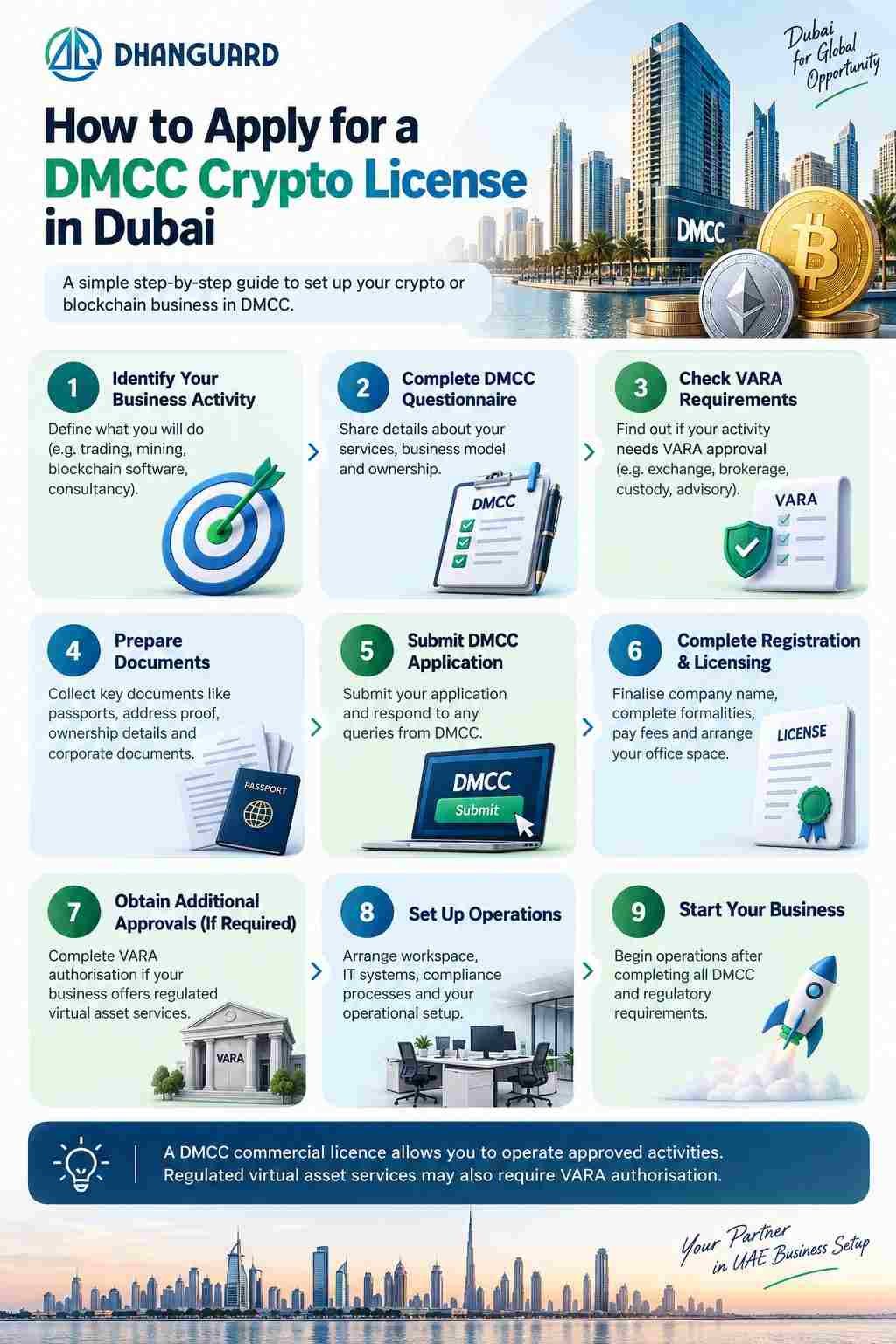
The DMCC company formation process and any required VARA authorisation should be planned together. This helps the applicant avoid establishing a company under an activity that does not match its intended operations.
Step 1 – Identify Your Cryptocurrency Business Activity
Start by defining exactly what the company will do. For example, determine whether the business will develop blockchain software, operate mining equipment, trade its own virtual assets, provide investment advice or manage customer portfolios.
Prepare a clear description of the services, customer base and revenue model. This information will help DMCC assess the appropriate commercial activity and identify whether further regulatory review may be necessary.
Step 2 – Complete the DMCC Crypto Centre Questionnaire
The applicant must complete the DMCC Crypto Centre questionnaire, which helps the authority understand the proposed business.
Provide accurate information about the company's services, operating model and ownership. If the company intends to provide more than one service, explain each service rather than describing the business in broad terms.
DMCC can then assess the proposed model and advise on the appropriate activity and application route.
Step 3 – Assess Applicable VARA Requirements
Before proceeding too far with company formation, review whether the proposed services fall within VARA's regulatory perimeter.
This is especially important for businesses planning to offer exchange, brokerage, custody, advisory, management or investment services.
If the business involves proprietary trading, check whether a VARA NoC or registration is required under the applicable conditions.
The applicant should understand the regulatory route, expected documentation and financial commitments before finalising the setup budget.
Step 4 – Prepare the Required Documents
Collect the initial documents required by DMCC, including shareholder passports, residential address evidence and any applicable parent company documents.
Also prepare ownership details, corporate authorisations and other information that may be required during the application.
Where VARA authorisation is required, begin preparing the regulatory business plan, financial information, governance documents and compliance framework.
Step 5 – Submit the DMCC Company Application
Once the activity and documents have been reviewed, proceed with the DMCC application.
The authority will assess the information and may request clarification or additional documents. Applicants should respond promptly and ensure that the information supplied is consistent across all forms and supporting records.
Step 6 – Complete Company Registration and Licensing Formalities
After the application progresses through the required checks, the applicant completes the relevant company incorporation and licensing formalities.
These may include:
- Finalising the company name and structure.
- Completing the required registration documents.
- Signing constitutional documents.
- Paying the applicable fees.
- Completing establishment and immigration formalities, where relevant.
- Arranging the approved office or workspace.
The exact steps depend on the company's structure and the requirements communicated by DMCC.
Step 7 – Obtain Additional Regulatory Approval, Where Required
If the proposed activity requires VARA authorisation, the company must complete the applicable regulatory process.
Company incorporation and VARA authorisation are separate matters. The applicant should not begin regulated virtual asset services simply because the DMCC company has been established or its commercial licence has been issued.
Step 8 – Complete Office and Operational Requirements
The company should arrange its approved workspace and prepare the operational resources required for its activity.
Depending on the business model, this may involve:
- Co-working or private office arrangements.
- IT systems and secure infrastructure.
- Mining equipment and suitable premises.
- Employee onboarding.
- Compliance and record-keeping systems.
- Internal policies and procedures.
- Banking and payment arrangements, subject to provider approval.
A regulated business may also need to demonstrate operational readiness to VARA.
Step 9 – Commence Permitted Business Activities
The company should begin operations only after completing the commercial and regulatory requirements applicable to its business model.
A company carrying out non-regulated activities must still comply with its approved DMCC activity and other applicable UAE laws. A company requiring VARA authorisation must wait until the relevant permission has been granted and any operating conditions have been satisfied.
VARA Licensing Process for DMCC Crypto Businesses
For a DMCC company intending to provide regulated virtual asset services, the VARA process is a separate and important part of the setup.
VARA describes the application for new firms as a two-stage process. The first stage involves an Initial Disclosure Questionnaire (IDQ) and Approval to Incorporate (ATI). The second stage involves the full VASP licence application.
Stage 1 – Initial Disclosure Questionnaire (IDQ)
The applicant begins by submitting an Initial Disclosure Questionnaire through the relevant commercial licensor or free zone.
The IDQ provides VARA with an initial understanding of the proposed business, its activities and its ownership and management arrangements.
The applicant may be asked to provide additional information, including:
- Business plan.
- Details of beneficial owners.
- Senior management information.
- Proposed regulated activities.
- Other information required for the initial assessment.
Initial application fees are also payable as required by the process.
Stage 2 – Approval to Incorporate (ATI)
If the application progresses successfully through the initial assessment, the applicant may receive Approval to Incorporate.
ATI allows the business to proceed with legal incorporation and operational preparations. These may include arranging office space, onboarding employees and preparing the systems required for the regulated business.
However, ATI is not a VARA licence and does not permit the company to commence regulated virtual asset activities.
This is an important distinction. A company may be allowed to establish its legal entity and prepare its operations at this stage, but it must not provide the regulated services before receiving the required final authorisation.
Stage 3 – Company Incorporation and Operational Preparation
After receiving ATI, the applicant can complete the legal incorporation process through the relevant commercial licensor.
The company should also prepare its operational arrangements in line with the regulatory expectations communicated by VARA.
This may involve:
- Establishing the required office arrangements.
- Appointing relevant senior personnel.
- Preparing governance and compliance systems.
- Establishing technology and cybersecurity controls.
- Preparing financial and operational evidence.
- Developing customer protection and risk management procedures.
The required arrangements depend on the proposed regulated activity.
Stage 4 – Submission of the Full Regulatory Application
Once the company has completed the relevant preparation, it can submit the full VASP licence application in accordance with VARA's guidance.
The application may include corporate documents, governance information, financial projections, capital evidence, policies, procedures and details of key personnel. The company must demonstrate that it can meet the regulatory requirements for each activity it intends to conduct.
Stage 5 – Regulatory Review and Additional Information
VARA reviews the application and may request further information or changes. The review may involve meetings, interviews and additional document submissions. The regulator may examine the company's ownership, management, financial resources, compliance arrangements, technology systems and operational readiness.
Applicants should allow time for this review and avoid treating an initial application milestone as confirmation that final authorisation will be granted.
Stage 6 – Final Authorisation and Operating Conditions
If VARA is satisfied that the company meets the applicable requirements, it may issue the VASP licence, subject to any conditions communicated by the regulator.
The company must comply with those conditions and the applicable rulebooks before and after commencing operations.
The DMCC company licence and VARA regulatory approval remain separate requirements. ATI is not permitted to start regulated virtual asset services.
DMCC Crypto License Cost in Dubai
The cost of setting up a crypto business through DMCC depends on the proposed commercial activity, company structure, workspace, visa requirements and whether the business needs separate VARA authorisation.
The DMCC Crypto Centre package provides a published starting reference for eligible applicants. However, a company requiring VARA authorisation should budget separately for regulatory application and supervision fees, professional support, compliance infrastructure and ongoing operations.
DMCC Company Registration Fees
DMCC's published Crypto Centre package is listed at AED 31,000. The package includes the DMCC company licence and specified ecosystem benefits, including access to the Crypto Centre co-working facility.
The package price and inclusions should be reconfirmed before applying, as fees and package conditions may change. Additional requirements or services outside the package may result in further charges.
DMCC Crypto Centre Package Fees
The Crypto Centre package is designed for eligible crypto, blockchain and Web3 businesses.
The published package includes:
- DMCC company licence.
- Access to the DMCC Crypto Centre co-working facility.
- Ecosystem benefits.
- Access to relevant networking and business support opportunities.
- Applicable package discounts and benefits, subject to terms and conditions.
DMCC currently advertises a 50% discount on second-year renewal fees as part of its package benefits. The precise renewal amount and eligibility should be confirmed with DMCC before budgeting.
Crypto Business Licence Fees
The commercial licensing cost depends on the package and approved business activity. The AED 31,000 Crypto Centre package is a useful published reference, but it should not be assumed to cover every possible activity, regulatory approval, office requirement or professional service.
Applicants should request an itemised quotation that identifies what is included and what must be paid separately.
Office and Workspace Expenses
The workspace requirement depends on the company's activity and the package selected.
A company eligible for the Crypto Centre package may receive access to a co-working facility under the package terms. A business requiring a private office, additional space or specialised premises should budget separately.
Mining operations may have different premises and infrastructure requirements from a software development company.
Visa and Immigration Expenses
Visa costs depend on the number of shareholders and employees who require UAE residency, the company's eligibility and the applicable immigration requirements. Potential expenses may include:
- Establishment or immigration card charges.
- Entry permit.
- Medical examination.
- Emirates ID.
- Residence visa processing.
- Health insurance.
- Related government or service charges.
The number of visas available should be confirmed against the selected package and workspace arrangement.
Additional VARA Regulatory Fees
VARA's published fee schedule sets separate application and annual supervision fees for regulated virtual asset activities.
The following figures are the published fees for the relevant activity categories:
| VARA-Regulated Activity | Estimated Licence Application Fee (AED) | Estimated Annual Supervision Fee (AED) |
|---|---|---|
| Advisory services | 35,000–45,000 | 70,000–90,000 |
| Broker-dealer services | 90,000–110,000 | 180,000–220,000 |
| Custody services | 90,000–110,000 | 180,000–220,000 |
| Exchange services | 90,000–110,000 | 180,000–220,000 |
| Lending and borrowing services | 90,000–110,000 | 180,000–220,000 |
| Management and investment services | 90,000–110,000 | 180,000–220,000 |
| Transfer and settlement services | 35,000–45,000 | 70,000–90,000 |
| Category 1 VA issuance | 90,000–110,000 | 180,000–220,000 |
Note: VARA fees are indicative and subject to change. Annual supervision fees are recurring and separate from DMCC setup, visa, workspace and compliance costs. Confirm the latest applicable fees with VARA before budgeting.
Where a company applies for more than one regulated activity, additional activity fees may apply under VARA's fee schedule. The regulator's current rules should be checked before preparing the final budget.
These regulatory fees are separate from DMCC company formation charges. They also do not represent the full cost of obtaining and maintaining regulatory approval.
Compliance, Legal and Accounting Expenses
A regulated virtual asset business may need to spend considerably more on professional and operational support than a company carrying out only technology development.
Possible expenses include:
- Legal and regulatory advisory.
- AML/CFT compliance systems.
- Compliance personnel.
- Risk management support.
- Technology and cybersecurity infrastructure.
- Accounting and audit services.
- Regulatory reporting.
- Insurance, where applicable.
- Banking services and payment service arrangements.
Estimated DMCC Crypto Business Setup Cost
The following table provides a planning framework. Only the DMCC Crypto Centre package and VARA regulatory fees above are published fee references. The other figures are illustrative budgeting allowances, not official authority charges or guaranteed quotations.
| Cost Component | Indicative Planning Amount (AED) | Cost Classification |
|---|---|---|
| DMCC Crypto Centre package | 25,000–37,000 | Published package reference |
| Additional office or workspace | 0–30,000+ | Depends on package and premises |
| Visa and immigration expenses | 3,000–7,000 per person | Planning allowance; varies by application |
| Legal and company documentation support | 5,000–20,000+ | Professional service estimate |
| Accounting and bookkeeping | 3,000–12,000+ annually | Planning allowance |
| Compliance preparation and advisory | 10,000–50,000+ | Depends on regulatory scope |
| VARA application fee | 40,000–100,000 per regulated activity, as applicable | Published regulatory fee |
| VARA annual supervision fee | 80,000–200,000 per regulated activity, as applicable | Published regulatory fee |
Note: These figures are intended for preliminary budgeting. They are not a fixed setup quotation or a representation of the total cost for every crypto business. VARA capital requirements, additional activity fees, workspace, staffing, technology, legal support and compliance arrangements can materially change the investment required. Obtain an itemised quotation and confirm the latest authority fees before proceeding.
How Long Does It Take to Get a DMCC Crypto License?
The time required to establish a crypto company through DMCC depends on the application, documents, business activity and any additional regulatory approval. DMCC publishes an approximate four-week timeframe for obtaining a crypto trading licence. This should be treated as an indicative reference rather than a guaranteed timeline, particularly where the proposed business requires separate VARA authorisation.
Estimated DMCC Crypto Company Setup Timeline
| Setup Stage | Estimated Time | Why Does It Take This Long? |
|---|---|---|
| Business activity selection and initial assessment | 2–5 working days | The proposed crypto activity must be identified correctly to determine the applicable DMCC licensing route and whether additional regulatory approval is required. |
| DMCC questionnaire and document preparation | 3–7 working days | Shareholder details, proof of address, business information and other requested documents must be collected, checked and submitted accurately. |
| DMCC application and review | 5–10 working days | DMCC reviews the application, ownership structure, proposed activities and supporting information. Additional questions or due diligence can extend this stage. |
| Company registration and licence issuance | 5–10 working days | Name availability, approval of company documents, registration formalities and workspace arrangements can affect the time required. |
| Additional VARA regulatory process | Depends on the application; no fixed timeline | VARA follows a separate regulatory assessment involving initial disclosure, ATI, incorporation and operational preparation, followed by the full VASP application and review. |
| Final operational preparation | Depends on business readiness | Compliance arrangements, technology infrastructure, governance procedures and required personnel may need to be in place before regulated operations can begin. |
DMCC Application and Document Review
The initial stage involves defining the business activity, completing the Crypto Centre questionnaire and preparing the required documents.
The time required depends on how quickly the applicant can provide accurate shareholder information, business details and any additional documents requested by DMCC.
Company Registration and Licence Issuance
After the application progresses through the required checks, the company completes its registration and licensing formalities.
The timeline may be affected by:
- Company name availability.
- Shareholder and ownership structure.
- Completeness of documents.
- Corporate shareholder approvals.
- Activity-specific review.
- Workspace arrangements.
- Additional authority requirements.
Additional VARA Approval Timeline
A company that needs VARA authorisation should plan for a separate regulatory review. The process includes initial disclosure, ATI, incorporation and operational preparation, followed by the full VASP application and regulatory assessment.
The duration depends on the complexity of the business, the regulated activities involved, the quality of the submission and VARA's review. There is no single guaranteed timeline for all applicants.
Factors That May Affect the Application Timeline
The following issues can influence the overall setup period:
- Changes to the proposed business activity.
- Incomplete or inconsistent shareholder documents.
- Complex ownership or corporate structures.
- Requests for additional due diligence.
- Regulatory questions about the business model.
- Preparation of compliance and governance documents.
- Recruitment of required senior personnel.
- Technology and operational readiness.
- Additional regulatory approvals.
Applicants should plan the commercial and regulatory workstreams together instead of assuming that the company can begin regulated operations as soon as its DMCC licence is issued.
- Read More About- DMCC License
How to Renew a DMCC Crypto License?
A DMCC company must plan for licence renewal to maintain its commercial registration and continue its approved business activities. Crypto businesses should also review any separate regulatory permissions and compliance obligations that apply to their operations.
Renewal preparation should begin well before the licence expiry date. This gives the company time to review outstanding requirements, arrange payments and address any issues identified by the authority.
When Should You Renew Your DMCC Crypto License?
The company should check its licence expiry date and the renewal instructions issued by DMCC.
It is sensible to begin preparing in advance rather than waiting until the final days before expiry. The preparation period should allow enough time to review company records, confirm workspace arrangements and settle outstanding payments.
Regulated businesses should also check the status of their VARA authorisation and any ongoing regulatory obligations.
Documents Required for DMCC Crypto License Renewal
The exact renewal documents depend on the company's circumstances and the requirements communicated by DMCC.
The company may need to review or provide:
- Existing DMCC trade licence details.
- Shareholder and director information.
- Updated company records.
- Current office or workspace information.
- Establishment card details, where applicable.
- Outstanding payment information.
- Updated corporate documents, if changes have occurred.
- Additional documents requested by DMCC.
If the company has changed its shareholders, directors, ownership structure or business activities, the relevant changes may need to be approved or recorded before or during the renewal process.
Step-by-Step DMCC Crypto License Renewal Process
Step 1 – Check the licence expiry date
Review the current licence and identify the renewal deadline.
Step 2 – Review the company's records
Check shareholder details, director information, company documents and workspace arrangements.
Step 3 – Confirm the approved business activities
Ensure that the company continues to conduct activities within its approved commercial scope. If the business model has changed, discuss the required amendment with DMCC.
Step 4 – Check outstanding requirements
Review any unpaid charges, pending documents or other requirements communicated by DMCC.
Step 5 – Confirm the renewal quotation
Obtain the applicable renewal fee and package details from DMCC. Confirm whether any discounts or package benefits apply.
Step 6 – Submit the renewal application and payment
Complete the renewal formalities and provide any supporting information requested by the authority.
Step 7 – Obtain the renewed licence
After the authority completes its review and processes the renewal, retain the updated licence and company records.
DMCC Crypto Centre Package Renewal
The DMCC Crypto Centre package advertises a 50% discount on second-year renewal fees. The applicable benefit is subject to the package terms and conditions.
Companies should confirm the current renewal price, eligibility and package inclusions directly with DMCC. They should not assume that the first-year package price will remain the same for subsequent years.
VARA Authorisation and Regulatory Renewal Considerations
A company holding VARA authorisation must continue to meet its regulatory obligations after receiving approval.
This may include annual supervision fees, regulatory reporting, maintaining required capital, updating key personnel information and complying with applicable rulebooks and licence conditions.
The company should also notify the relevant authority of material changes where required.
DMCC licence renewal does not replace VARA's regulatory obligations. Both commercial and regulatory requirements must be maintained where applicable.
DMCC Licence Renewal Fees
The renewal fee depends on the applicable DMCC package, company requirements and current fee schedule.
The Crypto Centre package advertises a second-year renewal discount. However, the final amount should be confirmed with DMCC before payment.
Other expenses may arise if the company needs changes to its licence, workspace, immigration arrangements or corporate records.
- Read More About- DMCC License Cost
What Happens If You Fail to Renew Your DMCC Crypto License on Time?
Failure to renew by the applicable deadline can affect the company's ability to maintain its commercial status and continue operating under its approved licence.
Depending on the circumstances and authority rules, the company may face late charges, restrictions, suspension or other administrative consequences.
A company should not assume that it can continue conducting business as usual after its licence expires. It should contact DMCC promptly if it anticipates a delay or has already missed the renewal deadline.
For a regulated virtual asset business, the company must also ensure that its regulatory permissions remain valid and that it continues to satisfy VARA's requirements.
Compliance Requirements After Obtaining a DMCC Crypto License
Obtaining a commercial licence is only one part of establishing a crypto business. Companies must continue to comply with the laws and regulatory requirements applicable to their activities.
The level of compliance required depends on whether the company carries out technology services, mining, proprietary trading or regulated virtual asset services.
AML and CFT Compliance
Anti-Money Laundering (AML) and Counter-Terrorist Financing (CFT) requirements are important for businesses operating in the financial and virtual asset sectors.
Where applicable, companies must establish policies and procedures to identify and manage money laundering and terrorist financing risks.
For regulated virtual asset businesses, this may involve risk assessments, customer screening, transaction monitoring, escalation procedures and reporting obligations.
Know Your Customer (KYC) Procedures
Know Your Customer procedures help businesses identify and verify their customers.
Depending on the activity and applicable rules, a regulated business may need to:
- Collect customer identification information.
- Verify customer identity.
- Understand the nature and purpose of the customer relationship.
- Assess customer risk.
- Conduct enhanced due diligence where required.
- Maintain updated customer records.
KYC requirements should be proportionate to the business model and the applicable regulatory framework.
Transaction Monitoring and Record Keeping
Businesses carrying out regulated virtual asset activities may need systems to monitor transactions and identify unusual or suspicious activity.
Record-keeping procedures should cover relevant customer information, transactions, approvals, compliance reviews and other records required by the applicable rules. A clear record-keeping framework helps the company demonstrate that it is following its internal policies and regulatory obligations.
Regulatory Reporting
Regulated businesses may be required to submit reports, notifications and other information to the relevant authorities.
The reporting requirements depend on the activity and the company's regulatory status. Companies should identify their reporting responsibilities early and assign clear ownership to the relevant personnel.
Corporate Governance and Risk Management
A crypto business should have a clear management structure and defined responsibilities.
For regulated businesses, governance arrangements may need to address:
- Board and senior management responsibilities.
- Compliance oversight.
- Risk management.
- Internal controls.
- Conflicts of interest.
- Business continuity.
- Incident escalation.
- Regulatory notifications.
The framework should reflect the scale and complexity of the company's operations.
Cybersecurity and Data Protection
Crypto businesses rely heavily on digital infrastructure. A security incident can affect customer information, systems, virtual assets and business continuity.
Companies should assess their technology risks and establish suitable controls, which may include:
- Access controls and authentication.
- Secure data storage.
- Network monitoring.
- Vulnerability management.
- Backup and recovery arrangements.
- Incident response procedures.
- Employee security awareness.
- Protection of customer information.
Businesses handling customer assets or operating regulated platforms may face additional technology and security requirements.
Case Study – Setting Up a Cryptocurrency Business Through DMCC
An entrepreneur James Mitchell from Australia approached DhanGuard with plans to establish a cryptocurrency and blockchain technology business in Dubai. He wanted to understand the suitable DMCC licence, the applicable regulatory requirements and the estimated investment before proceeding.
During the initial consultation, James wanted clarity on the following:
- Which DMCC business activity would be suitable for his proposed blockchain and Web3 services?
- Would a DMCC Crypto Licence be sufficient to start the business?
- Would he need separate VARA approval for cryptocurrency-related operations?
- What documents would be required for company formation?
- What would be the estimated setup cost, including a company licence and one visa?
DhanGuard's Guidance
DhanGuard reviewed James's proposed business model and explained the difference between blockchain technology services and regulated virtual asset activities. The guidance covered the following:
- Business activity selection: Recommended assessing the appropriate DMCC activity for blockchain software development, Web3 applications and related technology services.
- DMCC licensing: Explained the DMCC Crypto Centre company formation route and the applicable package requirements.
- VARA requirements: Clarified that a DMCC commercial licence does not automatically permit regulated services such as exchange operations, custody or virtual asset investment management. Any future expansion into these activities would require a separate regulatory assessment.
- Documentation: Guided him on preparing his passport copy, residential address proof, completed DMCC Crypto Centre questionnaire and other documents requested by the authority.
- Setup planning: Prepared an indicative budget covering the DMCC package, visa, workspace and professional support.
Estimated DMCC Crypto Business Setup Cost
| Cost Component | Estimated Cost (AED) |
|---|---|
| DMCC Crypto Centre package | 31,000 |
| Additional workspace allowance | 0–10,000 |
| One visa and related processing | 3,000–7,000 |
| Legal and documentation support | 5,000–10,000 |
| Initial accounting and administration | 3,000–5,000 |
| Estimated Initial Investment | 42,000–63,000 |
Note: These figures are indicative planning estimates, not a fixed quotation. The final cost depends on the selected package, visa eligibility, workspace requirements and additional services. VARA application and supervision fees are not included because the proposed initial business model focuses on technology development rather than regulated virtual asset services.
Final Outcome
With a clearer understanding of the licensing route and regulatory requirements, James was able to plan his proposed Dubai business more effectively. The recommended approach was to establish the company under a DMCC activity approved for its intended blockchain and Web3 technology services.
DhanGuard also explained that if the business later expands into regulated virtual asset activities, the company must assess and obtain the applicable VARA authorisation before offering those services.
This approach helped James understand the estimated investment, documentation requirements and distinction between commercial licensing and regulatory approval before moving forward.
Common Mistakes to Avoid When Applying for a DMCC Crypto License
A crypto business application can become more complicated when the applicant has not clearly defined its activities or has misunderstood the difference between commercial licensing and regulatory approval.
The following mistakes should be avoided.
Selecting the Wrong Business Activity
Choosing an activity based only on its name can create problems later.
For example, a company intending to manage customer virtual asset portfolios should not select a technology development activity simply because it plans to use blockchain software.
The application should accurately describe the services, revenue model and customer relationship.
Confusing DMCC Licensing with VARA Authorisation
A DMCC commercial licence does not automatically authorise a company to conduct regulated virtual asset activities.
Businesses planning exchange, custody, brokerage, advisory or investment management services should assess VARA requirements before commencing operations.
Submitting Incomplete Documentation
Missing shareholder information, unclear ownership records or inconsistent business details can lead to additional questions and delays.
Applicants should review the document checklist before submission and ensure that the information is accurate.
Underestimating Regulatory and Compliance Expenses
The cost of establishing a regulated crypto business can extend well beyond company formation.
VARA application and annual supervision fees, capital requirements, compliance personnel, legal support, technology controls and ongoing reporting should be considered when preparing the budget.
Starting Regulated Activities Without Approval
A company should not begin regulated virtual asset services merely because it has received its DMCC commercial licence or VARA's ATI.
The relevant final authorisation must be obtained before the company starts the regulated activity, subject to any conditions imposed by the regulator.
How DhanGuard Can Help with DMCC Crypto License Setup
Establishing a crypto business in Dubai requires careful planning because commercial licensing and virtual asset regulation may involve separate processes.
DhanGuard can assist entrepreneurs in understanding the company formation requirements, preparing the application and coordinating the relevant setup steps.
Business Activity and Licence Assessment
DhanGuard can review the proposed business model and help identify the commercial activity that should be discussed with DMCC.
This includes understanding whether the business will focus on blockchain development, Web3 solutions, mining or other crypto-related services.
Where the proposed model may involve regulated virtual asset activities, the regulatory implications should be identified before the company proceeds.
DMCC Company Formation Assistance
DhanGuard can assist with the DMCC company formation process, including understanding the applicable package, preparing the required information and coordinating the relevant registration formalities.
The objective is to help the applicant establish a company with activities that reflect its intended operations.
Documentation and Application Support DhanGuard can help applicants organise the initial documents and review the information required for the company application.
This may include shareholder details, residential address evidence, corporate documents and business activity information.
Where additional regulatory documentation is needed, the applicant should obtain appropriate specialist support for the relevant VARA application.
Regulatory Coordination
DMCC commercial licensing and VARA authorisation serve different purposes. DhanGuard can help the applicant understand the distinction and coordinate the company formation steps with the relevant regulatory requirements.
The scope of assistance should be agreed in advance, particularly where the business requires specialist legal, compliance or regulatory advisory services.
Licence Renewal and Post-Incorporation Assistance After the company is established, DhanGuard can assist with understanding ongoing company administration and renewal requirements.
This may include renewal planning, reviewing the required documents, coordinating licence renewal formalities and identifying changes that may need to be reported to the authority.
Companies with VARA authorisation must separately maintain their regulatory permissions and ongoing compliance responsibilities.
Conclusion
The DMCC Crypto Centre provides an established commercial environment for entrepreneurs exploring cryptocurrency, blockchain and Web3 businesses in Dubai. However, the right setup depends on the services the company intends to provide. A blockchain software developer, a mining business and a virtual asset investment manager may all operate within the wider crypto sector, but their commercial activities and regulatory obligations can differ significantly.
Before applying, entrepreneurs should define their business model, confirm the appropriate DMCC activity and determine whether VARA authorisation is required. They should also prepare the necessary documents, budget for commercial and regulatory expenses separately, and understand the renewal and compliance responsibilities that continue after incorporation.
Planning for renewal should begin before the licence expiry date. Companies should maintain valid DMCC approvals, keep their corporate records updated, settle applicable renewal charges and review any separate regulatory permissions required for their operations.
If you are planning to establish a crypto, blockchain or Web3 business in Dubai, DhanGuard can help you understand the company formation route, prepare for the application and plan the relevant licensing steps. Visit DhanGuard's company formation services or explore its business setup packages to discuss your proposed business structure and requirements.
DhanGuard: All-in-One Solution for Business Setup in Dubai, UAE
DhanGuard is your ultimate one-stop solution for all your business needs. Whether you’re planning to set up a new company or expand your existing business in the UAE, we’ve got you covered with our comprehensive range of services. From Company Formation in UAE and Business Bank Account in UAE services to managing your financial and legal compliance, we provide everything you need under one roof.
Our services include:
- Company Formation in UAE and Dubai
- Opening a Business Bank Account in UAE and Dubai with a 99% success rate
- VAT & Corporate Tax Compliance
- Accounting, Bookkeeping, and Auditing Services
- Trade License Renewal
- Golden Visa Assistance
Let DhanGuard make your journey of Business Setup in Dubai seamless and hassle-free!